
The Toyota Vitz is a line of three- and five-door hatchback subcompact cars that was produced from 1999 until 2019 by the Japanese automobile manufacturer Toyota. Throughout its production, the name “Vitz” nameplate had been used consistently in Japan, with most international markets received the same vehicle under the Toyota Yaris name, or formerly as the Toyota Echo in some markets for the first generation. The Vitz was available in Japan from Toyota’s Netz Store dealerships.
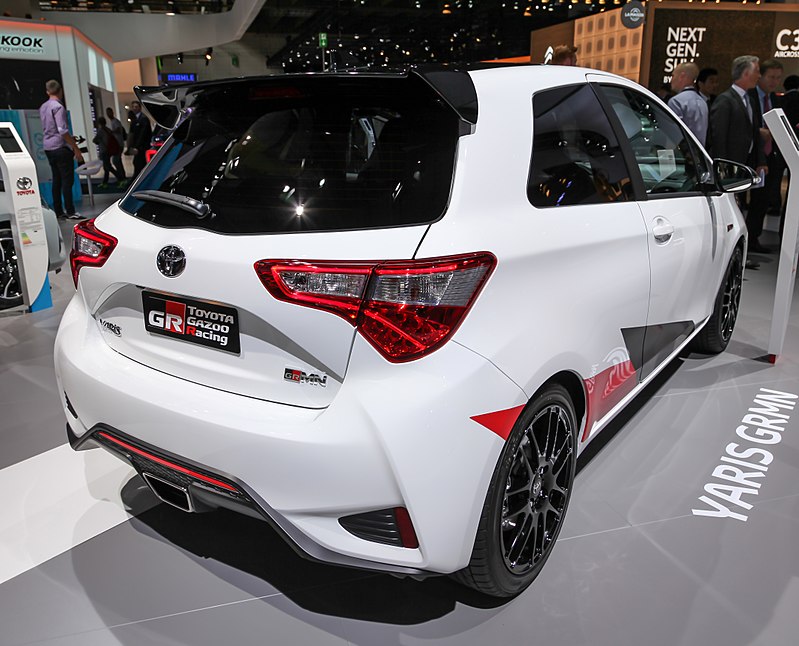
First generation (XP10; 1999–2005)
The first generation XP10 series Vitz was designed by Sotiris Kovos at Toyota’s ED2 studio in Europe.
It was first unveiled at the 1998 Paris Motor Show. Production began in late 1998,[8] with a Japanese on-sale date of January 1999; European sales commenced two months later as the “Toyota Yaris”.
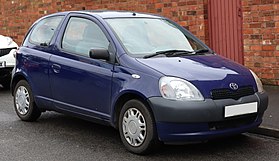
When introduced to Australasia in October 1999, the “Toyota Echo” name was used,as was the case in Canada when released there in 2003 for the 2004 model year.
The “Echo” and “Yaris” names were also given to the export version of the related Japanese market Toyota Platz sedan,also available as a coupé in North America.
Often sold alongside the hatchback and marketed as a single line of vehicles, exterior panels common between the Vitz and Platz were restricted to the front doors.
However, as Vitz and Platz were designed using the same platform, the mechanicals are largely identical and both share a common dashboard module.
There was also a “Yaris Verso” or “Echo Verso” variant sold in some export markets from late 1999, based on the Japanese “Toyota Fun Cargo”. The Verso MPV utilizes the same running gear as the Vitz, but features a more spacious interior.
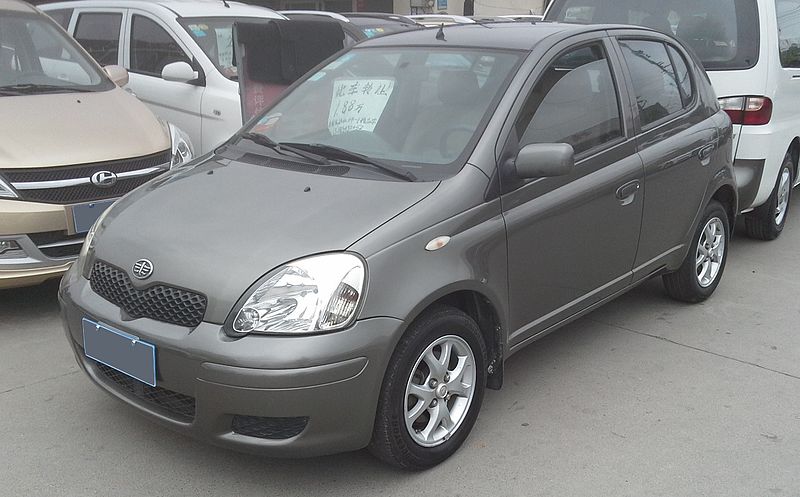
Instead of conventional analogue instruments, the Vitz utilized digital instruments which were moun
ted in a “pod” in the center of the dashboard. When sales commenced in the Canadian market this was not the case, with Toyota opting to fit a conventional speedometer, still mounted in the center of the dashboard.
Second generation (XP90; 2005–2011)
In 2003, the facelifted ‘Phase 2’ Vitz was released with different bumpers and ‘teardrop’ front lights.
Toyota redesigned the Vitz in early 2005, going on sale in Japan that February.
The Toyota Belta sedan shares underpinnings with the Vitz. However, while the Vitz was designed at Toyota’s European ED2 design studios, the Belta was designed at their Japanese design studios.
While the outgoing Vitz hatchback and Platz sedan look and feel virtually alike, the redesigned Vitz and Belta are more subtly related.
The two cars share a frame and the drivetrain components however the sheet metal is different.
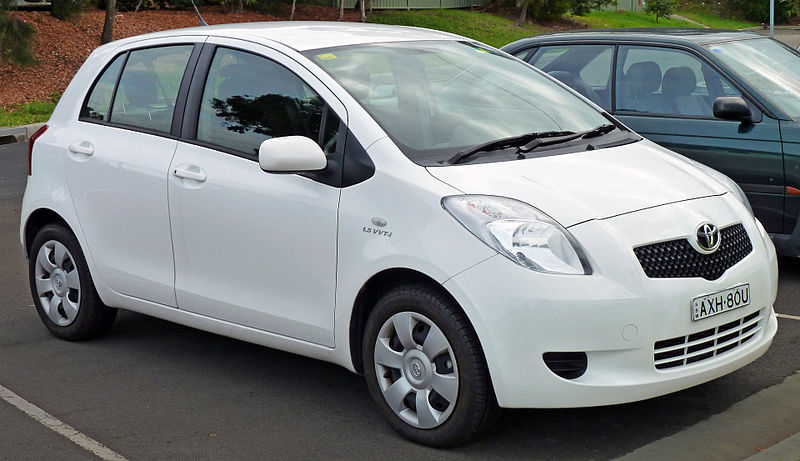
2011 Daihatsu Charade (Germany)
The European, Australian, Canadian, Mexican, Venezuelan and Puerto Rican markets saw the second generation Vitz near the end of 2005. In the Australian and North American markets, the car was sold as the “Yaris” for the first time. The production Yaris for the US market was unveiled at the Los Angeles Auto Show in January 2006. The XP90 series Yaris is built in Japan, France, and Thailand.
It also received a minor facelift in 2010 with slight subtle revisions to its bumper with in-built cornering protectors, air dams and an orange tinted signal on its tail lamps.
From 2011 to 2013, Daihatsu sold the XP90 Yaris under the “Daihatsu Charade” name as a Thai-produced five-door hatchback. Powertrains comprised a 1.3-litre engine and six-speed manual or optional automatic. The Charade was sold alongside the XP130 Yaris.
The XP90 continued to be built in China and Thailand until it was replaced by the XP150 in November 2013.
Third generation (XP130; 2011–2019)
The third generation Vitz was introduced in December 2010 featuring a sportier stance, a redesigned front and a roomier interior.
The new model uses a single windshield wiper instead of a pair of wipers and has its meter cluster positioned back in front of the driver and behind the wheel compared to its previous models.
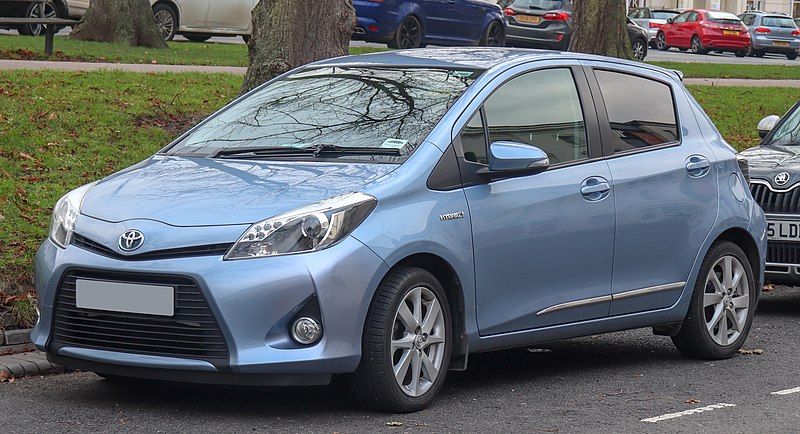
In European countries, the Yaris is also offered in 6-speed manual transmission for the 1.33L engine, or a CVT transmission often marketed as “7-speed MultiDrive” or “MultiDrive S”.
The 7-speed refers to the possibility to select a predefined gear ratio among 7 available, emulating a 7-speed sequential gearbox, with steering wheel levers.
_YR_5-door_hatchback_(2016-01-04)_01.jpg)
Toyota Motor Manufacturing France started to build the Yaris for export to the U.S., Canadian and Puerto Rican markets from May 2013 until 2019.

 MOTOR UNIVERSE